Building

Tampilkan postingan dengan label Mata Kuliah Reading. Tampilkan semua postingan
Speed Reading Test Online
Is Speed Reading for You?
Instructions
|
Get ready to read, click the Start button and start reading. The button starts the timer. Don't speed but read normally to find your present reading level.
Click the Stop button as soon as you have finished. This will stop the timer and display your reading speed.
Before you start the real test you may click Start, scroll down without reading, then click Stop to see what happens. You may also size the window of your browser to adjust column width. |
Speed Reading Test
|
If top readers read at speeds of above 1000 words per minute (wpm) with near 85% comprehension, they only represent 1% of readers. Average readers are the majority and only reach around 200 wpm with a typical comprehension of 60%. This seems surprising since most readers, actively reading work documents, newspapers, magazines, books or the contents of a computer display are practicing daily for at least one hour. With such an intense training everyone should be close to top performances. Unfortunately, this is far from the real situation. The average reader is five times slower than the good reader. Things are even worse if we consider reading efficiency as well as speed. Reading efficiency is reading speed weighted by comprehension rate and it amounts to 200 x 60% or 120 efficient words per minute (ewpm) for the average reader and to 1000 x 85% or 850 ewpm for top readers. Thus, an efficiency ratio of seven divides these two categories. Compare the results of the average reader to other areas. We may imagine a sprinter practicing every day for several years on the running track and then just calmly walking for a race. We can also picture a racing driver never exceeding 30 mph or a pianist playing every day of the week for 20 years and only able to play music like a beginner. Unfortunately, since the age of 12, most readers do not substantially improve their efficiency and never reach their full capacity. Every computer-user who is also a slow typist is aware of the benefits he could obtain with a typing course, but nearly no one suspects the much higher profits he could reach by improving his reading comprehension and speed. The rapid improvement of voice recognition may gradually make typing virtuosity obsolete since a good typist performs well under the speed of speech. On the other hand, human or computer speaking, with an average speed of 150 wpm, will always remain many times slower than a good reader, without any consideration of the skimming and skipping possibilities. There are three possible ways to improve reading. The fastest is probably a speed reading seminar based upon good materials and animated by a dynamic instructor. It is quite usual for a slow reader to double and even triple his reading efficiency during a two-day class offering a positive atmosphere, carefully selected texts and comprehension tests. However, as this rapid and encouraging improvement is not sufficiently anchored, it often fades with time. A book about speed reading is the second possibility. Such a book usually provides speed and comprehension tests as well as techniques to improve reading. It often includes more general information about concentration, interest stimulation, skimming techniques and ways to approach a text. Some methods may include audio or videocassettes. A book-based method requires a good deal of time as well as a strong commitment from the reader. Finally, a speed reading computer program is probably the most efficient way to achieve top reading levels. Computers offer unique exercises to boost reading efficiency through interactivity, text animation and pacing. Higher reading skills obtained with a computer screen are totally transferable to reading from paper. Unfortunately the inverse way does not work so well. Speed reading software delivers enjoyable and fast paced training, thus giving the consistent practice necessary to break lifelong slow reading habits. This is the task that seminars and speed reading books usually leave up to the reader. |


FASTER READING, THROUGH FASTER COMPREHENSION
Innovative Solution to Faster Reading
- Read Whole Ideas at a Time
- Strengthen Comprehension
- Sharpen Concentration
- Reduce Vocalization
- Improve Retention
- Increase Speed
"Visual" Reading
Imagine turning your reading into a mental movie, and projecting ideas into your mind. Visualize the meaning of complete groups of words, and send your mind what it craves; conceptual images. This powerful technique is unlike anything you've tried before.Reading Word-Groups
The key is reading short meaningful phrases, not simply 'chunks' of every 3 or 4 words. Practice reading text divided into distinct pieces of information. Read text grouped into 'thought-units', and see ideas practically leap from the page into your mind.Quick Results
You will probably be surprised how soon you'll see results. You won't just find a list of techniques about how to read faster; you'll start to read faster immediately, with specially formatted exercises that make it easy to understand whole groups of words at a time.Step-by-Step Progress
You will advance through a series of levels, steadily progressing towards reading word-groups on your own. Each level is carefully designed to steadily give you less assistance, advancing you towards the goal of using this skill in your normal reading.Common Sense Exercises
If you're skeptical, then you've probably tried other 'speed reading' courses. But this is not about 'eye-widening', or 'finger waving', or waiting for comprehension to 'catch up' with your 'speed reading'. Nor is this skimming, scanning, or ignoring 'unimportant' words. This is simply a convenient way to practice how fast readers read.Fun To Practice
Of course all skills require practice, but this practice is closer to fun than work. Enjoy reading popular classics while the specially formatted text makes it easy to see whole ideas at each glance. All books are divided into short segments so that you receive constant feedback of your progress every few minutes.See For Yourself
Have reading skills to be proud of, and truly experience text, rather than just listen to it. Read faster. Understand more.If you have too much reading to keep up with, or if you would simply like to enjoy a good book in a reasonable amount of time, then you must try this. The time invested to acquire this skill will be returned to you with every book you read.
Learning To Learn Faster Part II
The Backstory:
In my last blog, we got a chance to meet learning expert Jim Kwik and explored some of the ideas behind SuperheroYou, which is the Kwik-founded open-source community/university devoted to accelerated learning and brain optimization.
In May of this year, Kwik and SuperheroYou teamed up with Zappos CEO Tony Hsieh and the Downtown Vegas project to host a super-learning super-summit in, of course, downtown Las Vegas. It was a best-of-the-best gathering. Kwik sought out an assembled a collection of extraordinary minds to share their high performance learning hacks.
In the last post, we covered a small example of exactly this kind of brain optimizing hack: novelty. Our brains crave novelty. As a result, if you are trying to remember where you put your car keys, having an image of them 60 feet tall and dressed in drag helps. Mental exaggeration is a simple learning hack—a way of using the brain’s fundamental attraction to novelty as a way to optimize memory.
In this post, we’re going to examine a couple of similar tricks, one as a way to hack speed reading; the second as a way to accelerate problem solving, but before we can get into those details, first the “fish story.”
Hacking Reading
The fish story goes like this: A while back, Jim Kwik bumped into one of his old speed reading students (again, for more on Kwik and his reading talents, see my previous post) who told him he had just reread one of his favorite books using Kwik’s techniques.
The book in question was Hemingway’s classic The Old Man and the Sea. What had surprised the student the second time through was the vividness of the experience .
“He said he could feel the hot sun beating down on his shoulders as he read,” explains Kwik. “That he could actually hear the sound of the waves crash. It was amazing, he loved the whole book, except what he really couldn’t deal with was the smell of the fish.”
Where this fish smell comes from and what it has to do with accelerated learning is where this fish story gets interesting—but before we can get there we have to first cover a few speed reading techniques.
Over the course of his career, Kwik has discovered a few key reasons why most people read slowly, with back-skipping (re-reading passages over and again) and lack of focus among the most common.
The easiest way to solve these problems? Use a visual pacer. Your finger, a pencil, a computer mouse, whatever. This works so well because of another fundamental neuronal process: our eyes are attracted to motion.
We evolved in a world when a tiny rustle in the bush could have meant predator or could have been prey, but either way it paid to pay attention. So we do. We can’t help it. Which is why simply the use of a visual pacer improves reading speeds by 25 percent.
But Kwik tells his students to either use their left finger for that pacer; or hold that pacer (i.e. a pencil) with their left hand—and that’s where this story gets interesting.
Here’s why: The left side of the body is controlled by the right side of the brain. While brain function is not evenly lateralized, the right side is far more creative than the left. When we control a pacer with our left hand, we are actively engaging these same creative process. It happens subconsciously, it happens automatically, but by engaging the right side of the brain we’re firing up the imagination which, in turn, fires us sense memory—which is why that student smelled fish.
But here’s the thing—the more we engage imagination to process information, the more vivid the real time experience of that information, and the much more likely we’re able to recall that data later.
Simply by using our left finger as a visual pacer we are using the brain’s own inner workings to our advantage. In a very real sense, we’re hacking the subconscious with the subconscious—and the result is extreme vivid and detailed recall.
In my last blog, we got a chance to meet learning expert Jim Kwik and explored some of the ideas behind SuperheroYou, which is the Kwik-founded open-source community/university devoted to accelerated learning and brain optimization.
In May of this year, Kwik and SuperheroYou teamed up with Zappos CEO Tony Hsieh and the Downtown Vegas project to host a super-learning super-summit in, of course, downtown Las Vegas. It was a best-of-the-best gathering. Kwik sought out an assembled a collection of extraordinary minds to share their high performance learning hacks.
In the last post, we covered a small example of exactly this kind of brain optimizing hack: novelty. Our brains crave novelty. As a result, if you are trying to remember where you put your car keys, having an image of them 60 feet tall and dressed in drag helps. Mental exaggeration is a simple learning hack—a way of using the brain’s fundamental attraction to novelty as a way to optimize memory.
In this post, we’re going to examine a couple of similar tricks, one as a way to hack speed reading; the second as a way to accelerate problem solving, but before we can get into those details, first the “fish story.”
Hacking Reading
The fish story goes like this: A while back, Jim Kwik bumped into one of his old speed reading students (again, for more on Kwik and his reading talents, see my previous post) who told him he had just reread one of his favorite books using Kwik’s techniques.
The book in question was Hemingway’s classic The Old Man and the Sea. What had surprised the student the second time through was the vividness of the experience .
“He said he could feel the hot sun beating down on his shoulders as he read,” explains Kwik. “That he could actually hear the sound of the waves crash. It was amazing, he loved the whole book, except what he really couldn’t deal with was the smell of the fish.”
Where this fish smell comes from and what it has to do with accelerated learning is where this fish story gets interesting—but before we can get there we have to first cover a few speed reading techniques.
Over the course of his career, Kwik has discovered a few key reasons why most people read slowly, with back-skipping (re-reading passages over and again) and lack of focus among the most common.
The easiest way to solve these problems? Use a visual pacer. Your finger, a pencil, a computer mouse, whatever. This works so well because of another fundamental neuronal process: our eyes are attracted to motion.
We evolved in a world when a tiny rustle in the bush could have meant predator or could have been prey, but either way it paid to pay attention. So we do. We can’t help it. Which is why simply the use of a visual pacer improves reading speeds by 25 percent.
But Kwik tells his students to either use their left finger for that pacer; or hold that pacer (i.e. a pencil) with their left hand—and that’s where this story gets interesting.
Here’s why: The left side of the body is controlled by the right side of the brain. While brain function is not evenly lateralized, the right side is far more creative than the left. When we control a pacer with our left hand, we are actively engaging these same creative process. It happens subconsciously, it happens automatically, but by engaging the right side of the brain we’re firing up the imagination which, in turn, fires us sense memory—which is why that student smelled fish.
But here’s the thing—the more we engage imagination to process information, the more vivid the real time experience of that information, and the much more likely we’re able to recall that data later.
Simply by using our left finger as a visual pacer we are using the brain’s own inner workings to our advantage. In a very real sense, we’re hacking the subconscious with the subconscious—and the result is extreme vivid and detailed recall.
Narrative Text Structures
Belajar bahasa inggris tidak akan lepas “wajib” tentang narrative
text. Dalam pelajaran ini siswa biasa nya dituntut untuk bisa
menceritakan sebuah kisah atau dongeng ataupun cerita dalam bentuk
tulisan. Meskipun “storytelling” adalah salah satu komponen spoken
english sekaligus meramaikan pelajaran ini, narrative text nyatanya
lebih dominan diajarkan dalam bentuk tulisan, memahami generic structure
sebuah cerit ataupun menganalisa karakter, latar, ataupun alur cerita
narrative.

Berikut dibawah ini adalah penjelasan tentang narrative text :
(Narrative bermakna : 1. sebuah cerita baik terucap atau tertulis
tentang peristiwa-peristiwa yang berhubungan. 2. bagian yang diceritakan
dalam sebuah karya sastra, berbeda dengan dialog. 3. Praktik atau seni
bercerita)
Bagi sobat yang masih duduk di bangku sekolah tingkat menengah,
penjelasan mengenai narrative texts tak usah sulit-sulit ya.. Intinya,
narrative text ini mempunyai struktur / susunan seperti di bawah ini :
Berikut dibawah ini adalah penjelasan tentang narrative text :
Pengertian Narrative Text
Disebutkan bahwa A narrative text is an imaginative story to entertain people (teks narasi adalah cerita imaginatif yang bertujuan menghibur orang).
Jika melihat pada kamus bahasa Inggris, secara harfiah narrative bermakna (1)
a spoken or written account of connected events; a story. (2) the
narrated part of a literary work, as distinct from dialogue. (3) the
practice or art of narration.
 |
| Cerita Narrative Text |
Jika disimpulkan, maka sebuah narrative text adalah teks yang
berisi sebuah cerita baik tertulis ataupun tidak tertulis dan terdapat
rangkaian peristiwa yang saling terhubung.
Generic Structure dari Narrative Text
- Orientation : It is about the opening paragraph where the characters of the story are introduced.(berisi pengenalan tokoh, tempat dan waktu terjadinya cerita (siapa atau apa, kapan dan dimana)
- Complication : Where the problems in the story developed. (Permasalahan muncul / mulai terjadi dan berkembang)
- Resolution : Where the problems in the story is solved. Masalah selesai, — secara baik “happy ending” ataupun buruk “bad ending”.
Kadangkala susunan (generic structure) narrative text bisa berisi: Orientation, Complication, Evaluation, Resolution dan Reorientation. Meski “Evaluation” dan “Reorientation” merupakan optional; bisa ditambahkan dan bisa tidak. Evaluation berisi penilaian/evaluasi terhadap jalannya cerita atau konflik. Sedangkan Reorientation berisi penyimpulan isi akhir cerita.Jika
sudah mahir membuat cerita narrative, susunannya bisa diubah-ubah kok,
yang terpenting bagian-bagian di atas masih tetap ada dalam tulisan
narrative sobat.
Grammar (tata bahasa) yang sering muncul dalam membuat narrative text adalah:
Menggunakan tenses “Past”, baik simple, past perfect, past continuous, past perfect continuous, atau bisa saja past future continuous. (aturan ini bukan aturan wajib yang mutlak harus dipenuhi kok. Tidak percaya, tanyakan pada guru bahasa Inggris sobat)
Untuk lebih jelasnya, lihat contohnya di bawah ini :
Sincere Will Get a Great Return
Grammar Used dalam Narrative Text
Menggunakan tenses “Past”, baik simple, past perfect, past continuous, past perfect continuous, atau bisa saja past future continuous. (aturan ini bukan aturan wajib yang mutlak harus dipenuhi kok. Tidak percaya, tanyakan pada guru bahasa Inggris sobat)
Untuk lebih jelasnya, lihat contohnya di bawah ini :
Contoh Narrative Text (1)
Once upon a time, there was a kingdom named Auretto, all people lived peacefully there. One of them was Charlita, the king’s daughter who was assumed as the most beautiful and kindest Princess of Auretto.One day, Charlita looked blue. Because of that her father got confused. “What’s the matter my beautiful daughter? Why are you so sad?” asked King Fernando. Charlita was just silent. She did not say anything.Then, King Fernando decided to make a competition to cheer Charlita again. After that, the palace representative announce: “I will make a competition. The aim is to make my daughter, Princess Charlita to be happy and laugh again. Everyone who can do it, will get a prize. It will be held tomorrow when the sun rises. Sign: King Fernando.”The following morning, everybody came to the palace, tried to give their best performance. They seemed happy and laugh, but not for Princess Charlita. She was just silent and still looked sad.King Fernando started to give up. No one amused his daughter. Then, there came a young handsome man. “Excuse me King Fernando. I would like to join your competition. But, would you mind if I took Princess Charlita for a walk?” said the young man gently. “As long as you make my daughter be happy again, it will totally alright.” said King Fernando. The young handsome man took Princess Charlita for a walk in a beautiful blue lake with a green forest around it. Princess Charlita smiled and looked happy after that. Every body looked happy, too. “I know why are you so my beautiful daughter. Now, I promise I will environment green. I regret for always destroying it. Finally, the environment around the kingdom became so beautiful and green, full of plants. Then, the young handsome man got a prize from the king. “I will marry you off my daughter.” said him. “That is the prize I promise for you. Thanks for keeping our environment well. Thanks for making my daughter happy again.”
Contoh Narrative Text (2)
The Legend of Rawa Pening
Once upon a time, there was a little poor boy came into a little village. He was very hungry and weak. He knocked at every door and asked for some food, but nobody cared about him. Nobody wanted to help the little boy.Finally, a generous woman helped him. She gave him shelter and a meal. When the boy wanted to leave, this old woman gave him a “lesung”, a big wooden mortar for pounding rice. She reminded him, “please remember, if there is a flood you must save yourself. Use this “lesung” as a boat”. The “lesung” was happy and thanked the old woman.The little boy continued his journey. While he was passing through the village, he saw many people gathering on the field. The boy came closer and saw a stick stuck in the ground. People challenged each other to pull out that stick. Everybody tried, but nobody succeeded. “Can I try?” asked the little boy. The crowd laughed mockingly. The boy wanted to try his luck so he stepped forward and pulled out the stick. He could do it very easily. Everybody was dumbfounded.Suddenly, from the hole left by stick, water spouted out. It did not stop until it flooded the village. And no one was saved from the water except the little boy and the generous old woman who gave him shelter and meal. As she told him, he used the “lesung” as a boat and picked up the old woman. The whole village became a huge lake. It is now known as Rawa Pening Lake in Salatiga, Central Java, Indonesia.
Penjelasan Narrative Text (untuk tingkat Mahir)
Untuk mengetahui definisi dan penjelasan tentang narration (narrative text) sobat mahasiswa dan mahasiswi bisa membaca buku buku tentang writing di perpustakaan terdekat dan terlengkap, dan disini saya hanya akan mengutipkan pendapat Thomas S. Kane (2000: 363-364) di bawah ini:A narrative is a meaningful sequence of events told in words. It is sequential in that the events are ordered, not merely random. Sequence always involves an arrangement in time (and usually other arrangements as well). A straightforward movement from the first event to the last constitutes the simplest chronology. However, chronology is sometimes complicated by presenting the events in another order: for example, a story may open with the final episode and then flash back to all that preceded it.A narrative has meaning in that it conveys an evaluation of some kind. The writer reacts to the story he or she tells, and states or implies that reaction. This is the “meaning,” sometimes called the “theme,” of a story. Meaning must always be rendered. The writer has to do more than tell us the truth he sees in the story; he must manifest that truth in the characters and the action.Characters and action are the essential elements of any story. Also important, but not as essential, is the setting, the place where the action occurs. Characters are usually people—sometimes actual people, as in history books or newspaper stories, sometimes imaginary ones, as in novels. Occasionally characters are animals (as in an Aesop fable), and sometimes a dominant feature of the environment functions almost like a character (the sea, an old house).The action is what the characters say and do and anything that happens to them, even if it arises from a nonhuman source—a storm, for instance, or a fire. Action is often presented in the form of a plot. Action is, so to speak, the raw material; plot, the finished product, the fitting together of the bits and pieces of action into a coherent pattern. Usually, though not invariably, plot takes the form of a cause-and effect chain: event A produces event B; B leads to C; C to D; and so on until the final episode, X. In a well-constructed plot of this kind we can work back from X to A and see the connections that made the end of the story likely and perhaps inevitable.Stories can be very long and complicated, with many characters, elaborate plots, and subtle interpenetration of character, action, and setting. In writing that is primarily expository, however, narratives are shorter and simpler. Most often they are factual rather than imaginary, as when an historian describes an event. And often in exposition an illustration may involve a simple narrative. Being able to tell a story, then, while not the primary concern of the expository writer, is a skill which he or she will now and again be called upon to use.
Reading Faster
Tehnik Membaca Cepat Bahasa Inggris
BASIC SPEED READING TECHNIQUE
(Tehnik Dasar Membaca Cepat)
Selamat bergabung di Kuliah Bahasa Inggris mata kuliah Reading I. Materi ini
akan memberi pengayaan materi Reading 1. Kegiatan ini diharapkan dapat
membantu Anda untuk meningkatkan kemampuan dan keterampilan Anda dalam
membaca teks atau wacana dalam bahasa Inggris. Kegiatan kuliah ini insya Allah akan membantu Anda meningkakan pemahaman dalm membaca teks bahasa inggris secara cepat. Selain
sebagai ajang pembahasan materi, Anda dapat mengemukakan hal apa saja
dalam forum ini. Pergunakan kesempatan ini dengan sebaik mungkin.
Pada pertemuan I ini, Anda akan mengetahui tentang Basic Speed Reading Technique. Diharapkan Anda bisa meningkatkan kecepatan dan kemampuan membaca Anda tentunya dengan latihan-latihan sendiri!
Selamat Membaca. J
HOW DO YOUR EYES MOVE?
Pola 1
Secara umum mata kita membaca kata per kata dalam sebuah teks seperti yang ditunjukkan oleh pola di bawah ini. Mata membaca kata per kata, pada saat mata berhenti pada satu kata yang disebut dengan fixation, hal ini akan memakan waktu, yang mengakibat kegiatan membaca menjadi tidak efektif.
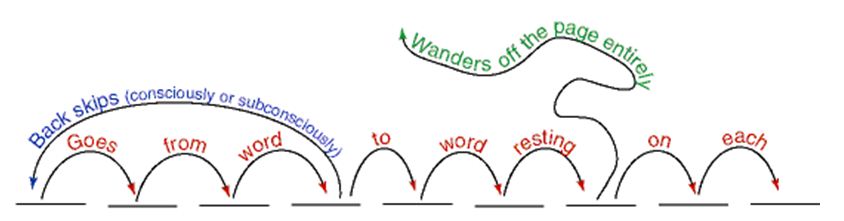
Seharusnya mata kita bergerak tidak seperti pola 1 diatas tapi seperti yang ditunjukkan pola 2 di bawah ini!
Pola 2

sehingga:
· Mengurangi fixations
· Membaca dalam kelompok-kelompok kata
- Selalu fokus pada bacaan
- Selalu membaca ke depan tidak mundur ke belakang
http://www.learning-tech.co.uk/Reading%20Tutorial%201.html
Kecepatan membaca Anda?
Untuk mengetahui kecepatan Anda, caranya:
Bagikan angka detik dengan angka 60 kemudian ditambah dengan angka menit.
Misalnya:
Jika Anda membaca selama 2 menit, 24 detik. Bagikan 24 dengan 60 kemudian tambahkan dengan 2 = 2,4 menit.
Jadi, berapa kecepatan Anda membaca kata per menit?
Cukup Anda bagikan jumlah kata pada sebuah teks dengan 2,4. Rata-rata kecepatan membaca adalah 200-240 kata per menit.
Misalnya, sebuah teks terdiri dari 643 kata kemudian Anda bagikan dengan 2,4. Sehingga diperoleh kecepatan membaca kata permenit = 268wpm (word per minute) atau 643/2,4=268wpm.
Exercise I
Berikut
adalah penggalan sebuah cerita yang terdiri dari 477 kata. Sekarang
Anda tentukan waktu sebelum membaca, usahakan membaca dengan menggunakan
pola 2.
Selamat membaca :)
Selamat membaca :)
HAIRCUT
Writed By Ring Lardner
I
got another barber that comes over from Carterville and helps me out
Saturdays, but the rest of the time I can get along all right alone. You
can see for yourself that this ain't no New York: City and besides
that, the most of the boys works all day and don't have no leisure to
drop in here and get themselves prettied up.
You're
a newcomer, ain't you? I thought I hadn't seen you round before. I hope
you like it good enough to stay. As I say, we ain't no New York City or
Chicago, but we have pretty good times. Not as good, though, since Jim
Kendall got killed. When he was alive, him and Hod Meyers used to keep
this town in an uproar. I bet they was more laughin' done here than any
town its size in America.
Jim
was comical, and Hod was pretty near a match for him. Since Jim's gone,
Hod tries to hold his end up just the same as ever, but it's tough
goin' when you ain't got nobody to kind of work with.
They
used to be plenty fun in here Saturdays. This place is jampacked
Saturdays, from four o'clock on. Jim and Hod would show up right after
their supper round six o'clock. Jim would set himself down in that big
chair, nearest the blue spittoon. Whoever had been settin' in that
chair, why they'd get up when Jim come in and at" it to him.
You'd
of thought it was a reserved seat like they have sometimes in a
theaytre. Hod would generally always stand or walk up and down or some
Saturdays, of course, he'd be settin' in this chair part of the time,
gettin' a haircut.
Well,
Jim would set there a w'ile without opening his mouth only to spit, and
then finally he'd say to me, "Whitey,"--my right name, that is, my
right first name, is Dick, but everybody round here calls me Whitey--Jim
would say, "Whitey, your nose looks like a rosebud tonight. You must of
been drinkin' some of your aw de cologne."
So I'd say, "No, Jim, but you look like you'd been drinkin' something of that kind or somethin' worse."
Jim
would have to laugh at that, but then he'd speak up and say, "No, I
ain't had nothin' to drink, but that ain't sayin' I wouldn't like
somethin'. I wouldn't even mind if it was wood alcohol."
Then
Hod Meyers would say, "Neither would your wife." That would set
everybody to laughin' because Jim and his wife wasn't on very good
terms. She'd of divorced him only they wasn't no chance to get alimony
and she didn't have no way to take care of herself and the kids. She
couldn't never understand Jim. He was kind of rough, but a good fella at
heart.
Berapakah kecepatan Anda membaca kata per menit?
Jawab:
Untuk
mengetahui tingkat kecepatan Anda dalam membaca gunakan rumus di atas
tapi kecepatan Anda dalam membaca belum teruji jika belum menjawab
pertanyaan di bawah ini. Usahakan untuk tidak melihat kembali teks
diatas.
1. What happened to Jim Kendall?
Answer:
2. Who was Jim Kendall’s best friend?
Answer:
3. What did Jim Kendall usually do on Saturday?
Answer:
4. Did Jim Kendall get married?
Answer:


